Description
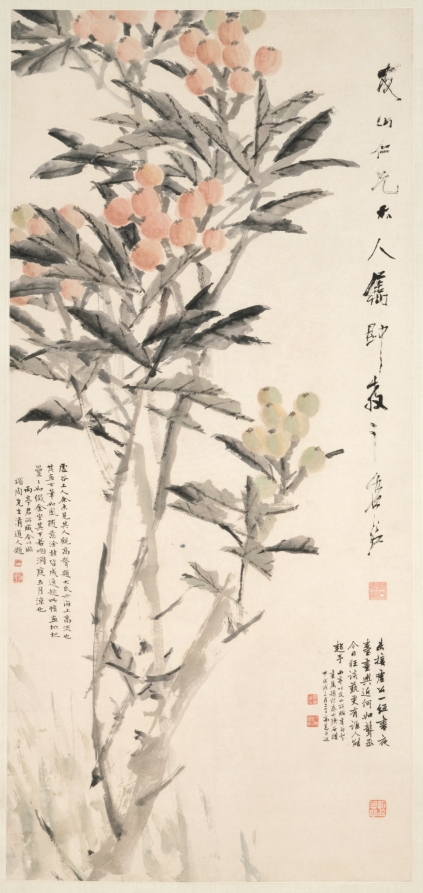
The loquat is a plant native to China that produces a juicy, yellow fruit in early summer. The artist may have intentionally extended the branches beyond the paper to emphasize the abundance of fruit. Xugu’s subjects of flowers, goldfish, and loquats express wishes for abundance and wealth, and must have appealed to his patrons.
Xugu gave up his career as a military official during the Taiping rebellion (1850–64) and became an itinerant monk who painted for a living. He spent the later years of his life in Shanghai and his fame as an artist is associated with that city.
Xugu gave up his career as a military official during the Taiping rebellion (1850–64) and became an itinerant monk who painted for a living. He spent the later years of his life in Shanghai and his fame as an artist is associated with that city.
Provenance
Youshan 友山 [late 19th century], given to Yuting (c. 1888-89–?); Yuting 雨亭 [late 19th century]; Zhang Songzhou 張頌周 [b. 1873], by descent to Zhang Bihan; Zhang Bihan (Chang Pi-han) 張碧寒 [1909–1995], Piedmont, CA (?–1995); (Kaikodo America, Inc., New York, NY, sold to the Cleveland Museum of Art) (?–1999); The Cleveland Museum of Art, Cleveland, OH (1999–)
Accession Number
1999.6
Medium
Hanging scroll; ink and color on paper
Dimensions
Painting: 112.6 x 52.2 cm (44 5/16 x 20 9/16 in.); Overall (no knobs): 231 x 70.5 cm (90 15/16 x 27 3/4 in.)
Classification
Painting
Credit Line
John L. Severance Fund